

Jared Borders

What excites you most about Artizo training?
I love the mixture of cohort-style learning and feedback mixed with getting practical mentorship in my local church. It is such a blessing to not feel like I’m doing ministry alone, and the feedback and encouragement I’ve received from others has been instrumental in my own growth and confidence.
How is Artizo different from other ministry internships or training roles you have witnessed or been a part of?
Artizo’s generous financial support, dedicated staff, cohort-style format, and accountability structures have all been unique to me based on prior experiences and talking with other students. It is such a blessing to know that Ben and his team, along with Jeremy at King’s Cross, are committed to providing support and opportunities, while giving oversight to the structure of my experiences. Artizo’s financial support has allowed me to dedicate more time to ministry training that would have otherwise gone into working part-time elsewhere, and it is such a blessing to learn alongside other Artizo apprentices.
What does Artizo add to your ministry preparation that you wouldn’t have otherwise?
Seminary provides needed head knowledge regarding biblical studies, theology, and spiritual formation, but Artizo has helped supply a much-needed gap by actually providing tangible experience in ministry. It is so uncommon to have the space to contribute meaningfully to church ministry, while also being surrounded by encouragement, mentorship, feedback, and financial support.
Xue Ting Fong

Xue Ting is an apprentice at St. Peter's Fireside Church
Steven Gomez

What excites you most about Artizo training?
I’ve been really enjoying getting to know my fellow apprentices in this cohort. The feeling of fellowship and community is becoming more solid week by week. This is the aspect of Artizo that I looked forward to the most, and I’m very glad to not be going on this journey alone.
What do you struggle most with as you contemplate a life in ministry?
Since hearing a call to walk the path of ordination discernment, I’ve struggled with the fact that I don’t know where the path is going. I can see it at my feet, but the way ahead is constantly rounding a curve that I can’t see past — the image I use for myself is of a labyrinth that curves and bends until it hits a centre; and what’s at the centre, I’m not sure. Each step I’ve taken, however small, has felt like a leap of faith I didn’t think I could make. I still don’t know where it’s going, but I’m learning to trust that Jesus is walking with me.
What does Artizo add to your ministry preparation that you wouldn’t have otherwise?
In addition to the communal fellowship, it feels like Artizo is providing a more structured and thorough training in the art of ministry than I would get otherwise. I get the chance to actually work in my church (King’s Cross), and my church family gets to see me as a ministry apprentice among them. In short, it feels like I have the support of friends and experienced leaders at my back, helping me learn and grow, and that is an enormous gift.
Kevin Hong

How did you hear about Artizo?
My orientation student host recommended Artizo to me in my first week at Regent, saying that of all the students he’s known at Regent, few he respected more than the Artizo apprentices. Indeed, they were some of the most gracious, thoughtful, and compelling people I’ve met there. One of them brought my wife and me to King’s Cross, where I was later invited to apply to Artizo.
What do you struggle most with as you contemplate a life in ministry?
Whether as an Artizo apprentice now or in any ministry work to come, I think I will always struggle to keep the fruit of my work from becoming the measure of my worth—both the pride of success and the shame of failure, magnified by the weight of spiritual work yet easily excused by the respectability of it.
How is Artizo different from other ministry internships or training roles you have witnessed or been a part of?
From my own ministry experience and hearing about other ministry internships, it’s easy to feel isolated and alone as an intern in churches big and small. Small churches might ease relationship-building, but few have multiple interns. A larger church might have more interns, but one can get lost in bureaucracy or siloed into limiting roles. Artizo avoids both pitfalls with a supportive cohort and an intentional ministry vision where the apprentice is not an afterthought.
Jude Johnson

What excites you most about Artizo training?
As I step into my Artizo apprenticeship, I am most excited about learning tools for thoughtfully and responsibly engaging Scripture, as well as how to then share that knowledge of Scripture with others. As someone with a background in literary studies, I am eager to train the Church to read Scripture well and to walk alongside my brothers and sisters in Christ as we meet the LORD through His written word.
What do you struggle most with as you contemplate a life in ministry?
As someone who has a deeply rooted love for academia, the arts, and the Church, I am trying to discern how to best interweave these passions in my life. Often these three areas can be disparate from—or even antagonistic toward—each other. As I pursue Artizo in conjunction with my studies at Regent College, I pray that God guides me into a deeper knowledge of how to connect these interests.
What does Artizo add to your ministry preparation that you wouldn’t have otherwise?
While I am receiving excellent theological training at Regent College, the academic setting fails to provide opportunities for daily ministry in a local church setting. Artizo allows me to leave the ivory tower and receive “on the ground” ministry experience in a specifically Anglican context. Being able to participate in staff meetings, receive mentorship from senior clergy, and develop practical skills for work in ministry are invaluable.
Aberdeen Livingstone

What did people say (or what did you read) that convinced you to apply to Artizo?
I was told that Artizo provides practical experience in ministry which would be an invaluable supplement to the rigorous academic training I would receive at Regent. Graduates also told me that the cohort model and the opportunity to receive regular, specific feedback on their ministry were some of the most formational parts of their Regent experience. I knew I wanted to find a way to use my intellectual training to bless the church, and I loved that Artizo provided the opportunity to be actively involved in local churches. I’m also incredibly thankful for the rare opportunity to be financially supported while pursuing these opportunities.
What do you struggle most with as you contemplate a life in ministry?
I struggle with the fear of talking more about God than I talk to Him or through Him. I also know my tendencies toward people-pleasing and finding my worth in a sense of my own moral performance, and I know that ministry will only exacerbate those vulnerabilities. I’m so grateful for Artizo’s commitment that our competency never outstrip our character and its relentless focus on the gospel as the center not only of our preaching but of our personal lives. I also appreciate the cohort and mentorship model of Artizo which remind me of truth and affirm my identity in Christ and His calling on my life even as my peers and leaders point out areas where I can grow.
How would you describe the need for ministry training within the wider church?
The need is great. I have read about and witnessed personally the decline in young people going into ministry, and those who do are often thrust into positions with insufficient training, both in practical skills and in character formation. Artizo stands in this gap, providing people a sustained period of intentional training and mentorship for a variety of ministry positions as they discern where God is leading them. I believe the churches its apprentices join, whether as members or as ministry leaders, will be better for it.
Rosanna Lo

What do you struggle most with as you contemplate a life in ministry?
Being a mother of a teenage girl and a pre-teen boy is a full-time job in itself. Add that to a life in ministry, where I wake up each day striving to be faithful in doing what God has called me to do. There are times I feel bad for missing out on a game or a performance of the kids when I’m engaged in ministry work; other times I question myself if the time I carve out is sufficient for youth group lessons preparation. While this challenge of mastering the art of time management can be overwhelming at times, I try to embrace this learning opportunity as much as I can, while it lasts.
How would you characterize the need for gospel-based teaching in Canada?
The perspective of the mother in me sees how challenging it is for youths to seek truths and wisdom in a very confusing world flooded with half-truths, partial truths, and even lies that resemble truths. To help this generation navigate through such roadblocks to the Way, the Truth, and the Life, the need for gospel-based teaching in this country is essential and irreplaceable yet easily neglected.
What does Artizo add to your ministry preparation that you wouldn’t have otherwise?
Preparing for a sermon and preaching has taught me to handle God’s Word with care and reverence. This one-of-a-kind learning experience has equipped me with useful techniques and is special to me, in particular, as I did not go to seminary, yet I hope to discern God’s calling.
Fuji Mooney

What excites you most about Artizo training?
Growing alongside other studious and pastorally-minded Christians is a great treasure at this point in our formation. Immediately upon entering the room together we started engaging, sharpening each other and pushing ourselves to be more carefully and effectively articulate for the sake of the Gospel. Cannon Rev. Ben and Rev. Phill also do a great job leading, balancing seriousness in training with good humour.
What do you struggle most with as you contemplate a life in ministry?
Striving to be worthy of the call. Yet is that not the trajectory on which all Christians find themselves? May God continue His sanctifying work in me, you, and all the Church! Amen.
How would you characterize the need for gospel-based teaching in Canada?
I would characterize the need as “very great”. Greater than any political or social issue is the love that God has for every person He has made - so there is obviously tremendous value in the Church boldly proclaiming the Gospel wherever there are ears to hear it.
Joshua Liu

How did you hear about Artizo?
I heard about Artizo by attending St. John’s Vancouver. I met two former Artizo apprentices, Jacob Vandiver and Zella Christenson, there. Though they did invite me to apply to Artizo, it was their example, which I desire to follow, that moved me to do so.
What does Artizo add to your ministry preparation that you wouldn’t have otherwise?
Artizo allows me to learn by closely watching and imitating exemplars of faithful pastoral ministry. I am immensely blessed to learn from Rev. Guy Bellerby and the Ven. Rev. Sean Love, two ministers who both by their life and teaching set forth God’s true and life-giving word. And I am also blessed to learn alongside an incredible cohort of apprentices.
What do you struggle most with as you contemplate a life in ministry?
Contemplating a life in ministry is itself the struggle. Who can fathom a whole life of carrying the weight of minister’s responsibility? To preach God’s word, guard the good deposit, duly administer the sacraments, finish the race, complete the task—all the while pride and prayerlessness and powers and principalities beset me? Enough! I shall contemplate Christ. His gaze will hold mine steady.
Jacob Vandiver

How did you hear about Artizo?
I initially heard about Artizo on the web in connection with Dr. Packer. I was exploring possibilities for formation in ANiC and stumbled upon the program by happenstance. I then heard great things about the program from a former apprentice – Josh Drury – who encouraged me to enquire. Then in the summer of 2022, during a chat with James Salladin (a visiting professor at Regent, a former St. John’s minister, and Artizo graduate himself), he highly encouraged me to join Artizo based on my interest in preaching and desire for pastoral formation.
What did people say (or what did you read) that convinced you to apply to Artizo?
Hearing from current apprentices about their experience in Artizo was a major factor in my decision to apply. I was influenced by apprentices sharing about formative and helpful experiences they received in their ministry placements working with St. John’s staff and clergy, the challenging and instructive practice of preparing and delivering sermons in the Artizo sessions with Ben Roberts, David Short, and Susan Norman, and about the rich experience of teaching and preaching on the ground in the context of a real congregation. All of this seemed like exactly what I was looking for to supplement my Regent education. Furthermore, I had a desire to be seriously trained for the preaching ministry. Jim Salladin told me, “There’s no better place in the world to learn to preach.” So I took his word for it and applied. My expectations have been met and exceeded!
What excites you most about Artizo training?
The weekly meetings where we share our work in scripture and give/receive feedback is one of the highlights of the Artizo experience. I’m also excited and blessed to have lots of opportunities to preach and minister in ANiC churches throughout the lower mainland of BC.
What do you struggle most with as you contemplate a life in ministry?
As my family and I contemplate our future in ministry, there are lots of exciting and perplexing questions around where and how we might settle into a ministry position. We are excited about the possibility of serving the church in Canada, but being from the US there are lots of complications to consider. Certainly the question of financial/housing sustainability is always on our minds. We are also often considering where might be a good fit for our family as a whole, particularly our oldest son who just began secondary school. We continually commit these things to prayer and we’re learning more and more to take a posture of receptivity and dependence upon the Lord’s provision.
How would you characterize the need for gospel-based teaching in Canada?
Canadian culture, as I’ve experienced it in the past few years, is deeply post-Christian and lacks a sense of grounding upon any transcendent values at all. The church has a unique opportunity in the Canadian context to proclaim God’s word and communally embody the gospel of Jesus Christ as an antidote to the toxic lack of meaning which exists in Canadian culture. Jesus is the answer to our hearts’ deepest longing, he represents and offers us real abundant life, he draws us together in true community, and he is the answer to the question of meaning which Canadians of this generation are asking. This is a message that desperately needs to be proclaimed in Canada.
Ryan Spear
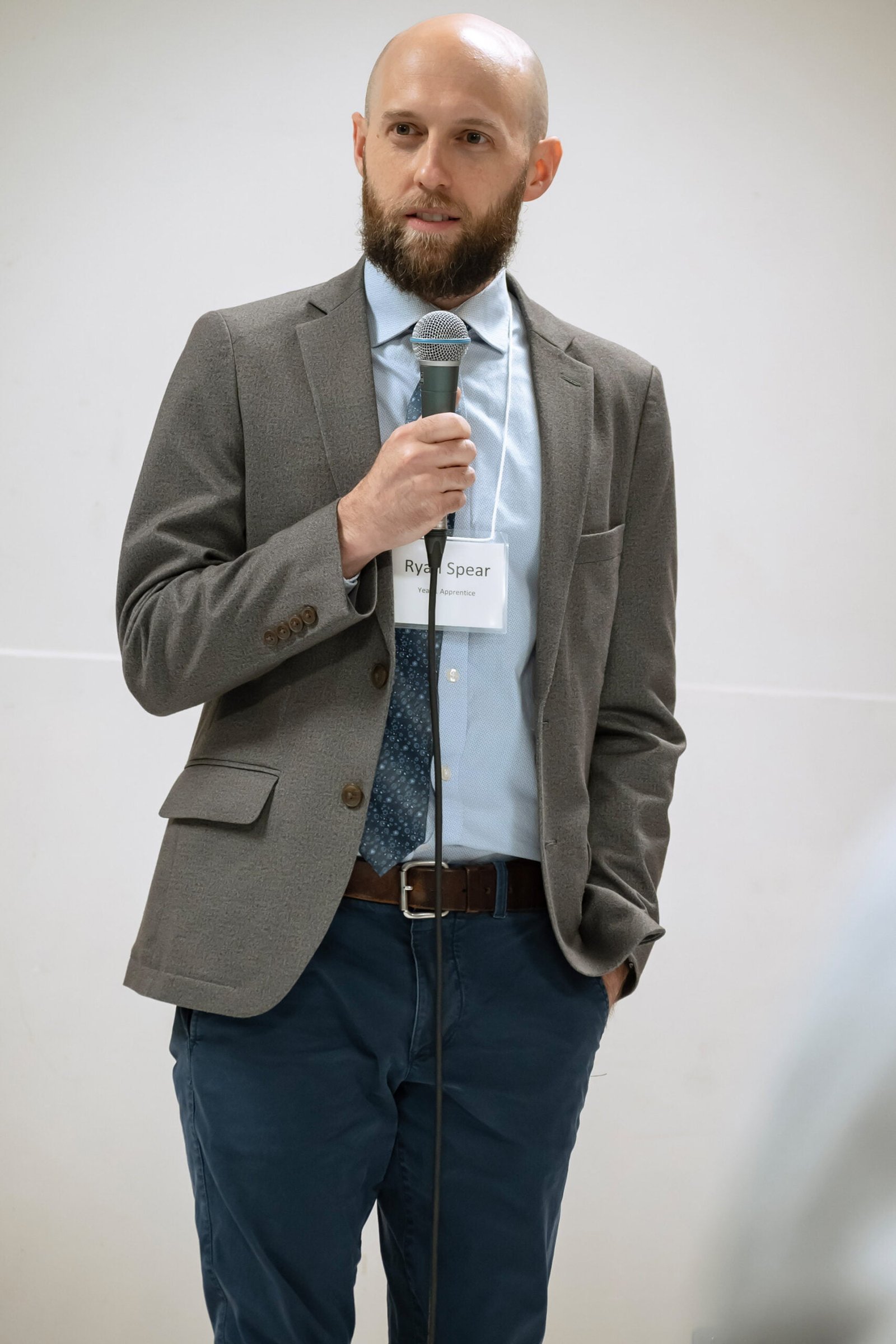
How did you hear about Artizo?
The first church we (Christie and our boys) attended upon relocating to Vancouver was St. John’s. In our conversations, upon learning we were here and studying at Regent, someone introduced me to Artizo. I was evangelized, you might say.
What did people say (or what did you read) that convinced you to apply to Artizo?
First, my father is a pastor and said that the best part of his training for ministry was his time placed in a church. Secondly, I was impressed with the people I was meeting and drawn to their company. Finally, I was struck by the thoughtfulness and comprehensiveness of the training.
What excites you most about Artizo training?
The weekly meetings and preparing for sermons are highlights of my time here so far. I experience joy in diving into God’s Word with others and then submitting to God’s Word in preparing to give a sermon.
What do you struggle most with as you contemplate a life in ministry?
Of course, there are the cares of this world – “Where will we live? In what ways will God provide for us?” Then there is the humbling thought of leading a congregation in a biblically faithful way, knowing the standards that teachers of God’s word are held to.
How would you characterize the need for gospel-based teaching in Canada?
As St. John’s wrapped up a series on Amos this summer, I was struck with his words about a different kind of famine that would be experienced – “a famine of hearing the words of the LORD” (Amos 8:11). Only the word of God can offer the rich feast so desperately needed in Canada today. And only gospel-based teaching that tells us the truth about our situation apart from God and his work to make all things new can truly feed us.